Start with a clear scope. A strong audit method helps teams measure how systems affect daily business operations. Define the step that sets goals, boundaries, and who owns each task.
Review current tools and measure performance, latency, pricing impact, and privacy controls. Note where security or information handling fails modern standards.
Document results and create action updates so the organization adapts to rapid changes. Effective frameworks give oversight and align solutions with federal and state regulations.
Remember the stakes: more than 100 federal and 600 state proposals are shaping governance now, and poor data integrity can cost up to 6% of annual revenue.
The final stage should assess workflows, user transparency, and training needs. This builds trust and uncovers opportunities to reduce compute waste while improving performance.
Defining the AI Tool Audit Checklist for Low-Energy Business Workflows
Kick off with a compact evaluation plan that tracks data quality, system fit, and operational risk. Use clear, measurable criteria so teams can spot gaps fast.
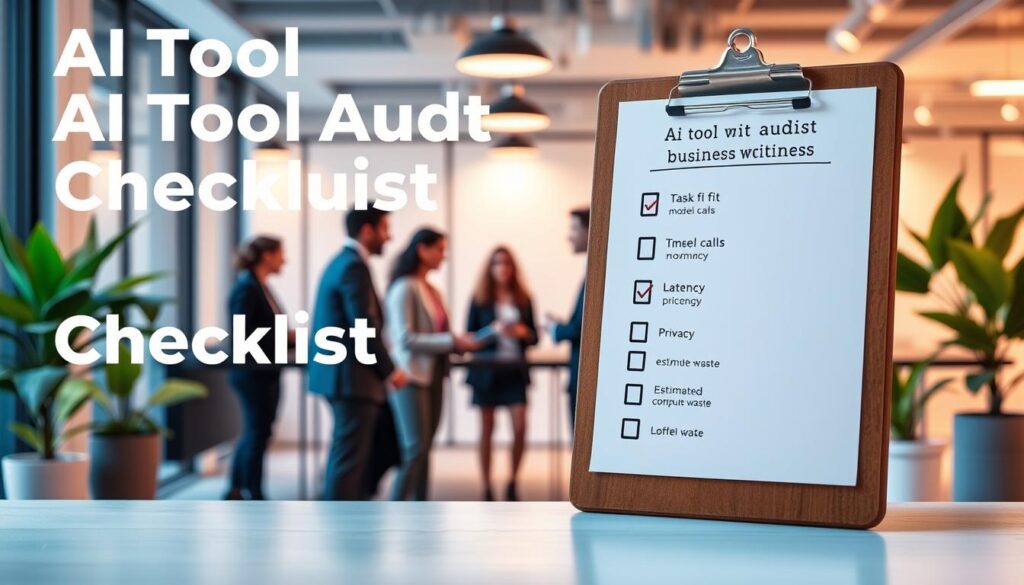
The checklist provides a structured way to review internal processes and systems. It highlights where tools fail, where data drifts, and where compliance might slip.
- Verify input quality and completeness; poor data can cost up to 6% of yearly revenue.
- Confirm outputs meet accuracy targets under normal workloads.
- Map each system to a single owner and a performance metric.
- Align checks with regulatory needs to keep operations compliant and resilient.
Research shows 74% of organizations now rely on business stakeholders to flag data problems first. That shift makes regular, short reviews essential to preserve quality and steady performance.
Establishing Audit Scope and Strategic Goals
Begin by defining which systems most affect your priorities and where oversight will matter most.
Set a short scope statement that ties strategic goals to measurable results. Note which data sources and business areas you will include. This step matters now, given the more than 100 federal and 600 state-level proposals in the United States that affect governance and compliance.
Identifying High-Risk Tools
Map every tool to a risk tier. Mark high-risk systems such as hiring platforms as candidates for immediate review and stricter standards.
Use simple criteria: impact on people, volume of personal information, and regulatory exposure. Prioritize systems that touch hiring, payments, or sensitive records.

Assembling Cross-Functional Teams
Form a core team with representatives from security, legal, product, and operations. Cross-functional input improves governance and transparency.
Document roles, stages of each system’s lifecycle, and planned review cadence. Regular updates to your inventory keep the process current as new solutions and changes arise.
- Step: Record strategic goals and expected impact on business results.
- Step: Define oversight, training needs, and areas to monitor for bias or failures.
- Step: Schedule assessments that produce actionable results and maintain trust.
Evaluating Task Fit and Operational Efficiency
Start by mapping recurring tasks to the teams that perform them and the time each task consumes.
Collect basic data on cycle time, error rates, and manual effort. This gives a clear baseline for any review and future implementation decisions.
Identifying Repetitive Time-Wasters
Look for simple repeatable steps that take staff away from higher-value work. For example, a local law firm cut scheduling time by 50% and drafted routine documents three times faster after targeted changes.
A boutique clothing store used a system to optimize ordering. That change reduced excess inventory by 28% and cut out-of-stock events by 35%.
- Evaluate each process to find manual data entry and duplicate tasks.
- Match systems to clear use cases that boost team productivity.
- Focus on improvements that lower error risk and improve quality.
| Task | Current Time | Potential Gain | Compliance / Risk |
|---|---|---|---|
| Client scheduling | 30 min per appointment | 50% faster | Low |
| Routine document drafting | 2 hours | 3x faster | Medium |
| Inventory ordering | Weekly manual review | 28% less excess | Low |
Every step of this evaluation should tie back to measurable business goals. Use the findings to prioritize implementations that improve performance while keeping compliance and quality intact.
Assessing Model Latency and Compute Waste
Track response times during live usage to understand how systems behave when information is messy. Measuring latency under real load reveals delays that lab tests often miss.
Measuring Real-World Latency
Collect timing data from production requests and group by endpoint, payload size, and peak hour. Use simple logs to record round-trip times and error rates.
Monitor how latency affects operations and user experience. Even small delays can cascade into slower workflows and lower quality results.
Calculating Compute Waste
Estimate wasted compute by tracking average compute per request and trimming unnecessary calls. For example, a bakery invested about $5k in a customer service bot and recovered an estimated $15k yearly by cutting workload.
Compare cost per successful response against targets to find opportunities to optimize tools and reduce risk of overspend.
- Measure latency by endpoint and time window to spot hotspots.
- Monitor data quality during live use to catch unexpected inputs that degrade performance.
- Review results to identify solutions that lower costs while keeping compliance and accuracy.
The final step in this assessment is to document findings, quantify savings, and set a recurring review cadence so systems keep delivering strong performance and reliable results.
Analyzing Pricing Models and Resource Allocation
Compare recurring fees and actual usage to prevent duplicate services that drain your budget. This step helps your team see where subscriptions add little value.
Review the security and privacy standards of every tool. Confirm you are not paying for redundant compliance features while missing needed data protections.
“Many small businesses now access upgraded versions for about $20 per month, showing high-impact solutions can be affordable.”
Track spend against measurable impact. Align training and security investments with long-term operations goals so costs support outcomes.
| Subscription | Monthly Cost | Usage | Compliance |
|---|---|---|---|
| Messaging | $15 | High | Basic |
| Document automation | $20 | Medium | Enhanced |
| Analytics | $30 | Low | Basic |
- Step: Reconcile invoices with real consumption monthly.
- Consolidate overlapping services to cut waste.
- Integrate data management with pricing to avoid hidden storage and processing costs.
Prioritizing Data Privacy and Security Compliance
Start each review by mapping where sensitive information flows through your systems and who can access it. This simple step reveals exposure points and sets the scope for the next compliance work.
Navigating regulatory standards means aligning policies, technical controls, and oversight so your team can act quickly when gaps appear. Robust frameworks are now expected as new regulations push fairness and data protection into law.
Navigating Regulatory Standards
Prioritize privacy controls that log access, encrypt stored information, and segment sensitive records inside production systems. Verify that processes enforce least privilege and clear retention rules.
For example, Microsoft raised facial recognition accuracy for darker-skinned women from 79% to 93% after a fairness audit that fixed biased data and model issues. That underscores why governance matters.
Make this a regular step in every audit cycle. Confirm compliance with current regulations, update security standards, and add oversight so your business maintains quality, reduces risk, and keeps stakeholder trust.
Testing Model Performance and Accuracy
Validate model outputs using representative production data so results match real-world needs. This step reduces surprises when systems handle messy inputs.
Metrics for Classification Models
Use clear metrics like AUC-ROC, precision, recall, and confusion matrices. These measures show where a classifier succeeds and where it fails.
Cross-validate across segments. A model with 92% accuracy can still miss specific groups. That gap creates risk and hurts overall performance.
Testing Under Real-World Conditions
Run tests with live-like data and peak loads. McKinsey found 44% of organizations saw negative outcomes from inaccuracies in production.
Record results, latency, and error patterns so teams can trace sources of failure.
Detecting Algorithmic Bias
Detect bias early by comparing predictions across demographics and use cases. Add oversight and transparent reporting to improve quality and meet standards.
- Measure fairness metrics and document areas of concern.
- Include human review on high-risk outputs.
- Feed findings back into development frameworks to lower future risk.
Implementing Human Oversight and Governance
Set clear human checkpoints that sit next to automated decisions so people can catch errors early. This step ties technical outputs to business goals and preserves trust in systems.
Start by defining governance roles and escalation paths. Make sure your team can override decisions when outputs pose a compliance or security risk.
Include measurable gates in the implementation plan. Use the data from real use to trigger human review. Studies show escalation prediction with 87% recall cut support workloads by 88% in practice.
Automating escalation workflows is an effective example. It can reduce procurement delays by 50% and prevent the 30% cost increase that inefficiencies cause at 60% of companies.
- Require human sign-off on high-risk outputs.
- Monitor performance and log decisions for later review.
- Build training and security checks that support human-in-the-loop use.
These governance steps make compliance easier, reduce operational risk, and help teams act on audit results quickly. Regular reviews keep systems aligned with regulations and business priorities.
Documenting Results and Continuous Monitoring
Store measurable results and remediation steps in a living log to guide future updates. Clear records help teams see progress, track compliance, and plan next actions. This final documentation step turns findings into repeatable improvements.
Establishing Feedback Loops
Define who owns each report and which metrics signal a problem. Log baseline data, test outcomes, and the specific fixes assigned to a team.
Set automated alerts when performance drifts beyond thresholds. Alerts let your team respond fast to changes in input data or system behavior. For example, an email or dashboard flag can trigger a review within hours.
- Document results so your business can measure impact and maintain compliance over time.
- Establish feedback loops that force regular updates and retraining as models and data evolve.
- Close each cycle with an action plan that lists owners, deadlines, and quality checks.
Continuous monitoring keeps governance effective and ensures tools continue to deliver reliable results. Make this a recurring step in every implementation to protect performance, compliance, and long-term value.
Conclusion
Conclude with a concise action plan that links results to budget and operational goals. Assign clear owners, set deadlines, and pick simple metrics to track progress.
Human oversight and continuous monitoring keep systems reliable and maintain trust. Use the data you collect to fix inefficiencies, reduce risk, and guide training needs.
Following this approach helps teams optimize resource allocation and performance. A well-executed review lets your organization leverage artificial intelligence while protecting data and the bottom line.