This guide lays out a practical buyer matrix to help teams pick the right model while keeping energy and efficiency top of mind. It summarizes standardized energy efficiency ratings and clear metrics so users can compare systems on real processing and power use.
We define common tasks and benchmark methods that reveal how models use hardware and data. Those ratings bring transparency to vendor maturity, logging practices, and integration effort. The aim is simple: better decisions that boost performance and reduce environmental impact.
Readers will find guidance on balancing cost, sustainability, and application needs. The matrix highlights how configuration, monitoring, and compact models can cut consumption without sacrificing text generation or other key applications.
Use this intro as a roadmap. The sections ahead expand on metrics, vendor signals, and actionable steps to choose energy-efficient models for practical deployments.
The Environmental Impact of Modern AI Systems
Increasing model scale and usage is driving measurable rises in electricity demand and lifecycle impacts. This section summarizes how computing growth translates into higher energy use, emissions, and wider environmental effects.
Global Electricity Consumption
Recent estimates place global electricity tied to modern systems at about 100 TWh in 2025, with a worst-case forecast of 1,370 TWh by 2035. In the United States, data centers could consume 6.7–12% of total electricity by 2028 as processing demand grows.
To meet that demand, the U.S. plans roughly 46 gigawatts of new natural gas capacity by 2030, a shift that risks increasing carbon emissions unless paired with cleaner generation and efficiency measures.

Environmental Life Cycle Impacts
Energy consumption is only part of the story. Training large models also raises concerns about water use, air pollution, and electronic waste from retired hardware.
Seminal research by Strubell et al. highlighted the high carbon footprint of training transformer-style models. A holistic view of supply chains, materials, and operations is essential to reduce the total environmental impact of these systems.
- Takeaway: Track electricity, cooling, and lifecycle costs together to see true environmental impacts.
Understanding the AI Tool Comparison Matrix for Energy-Conscious Buyers
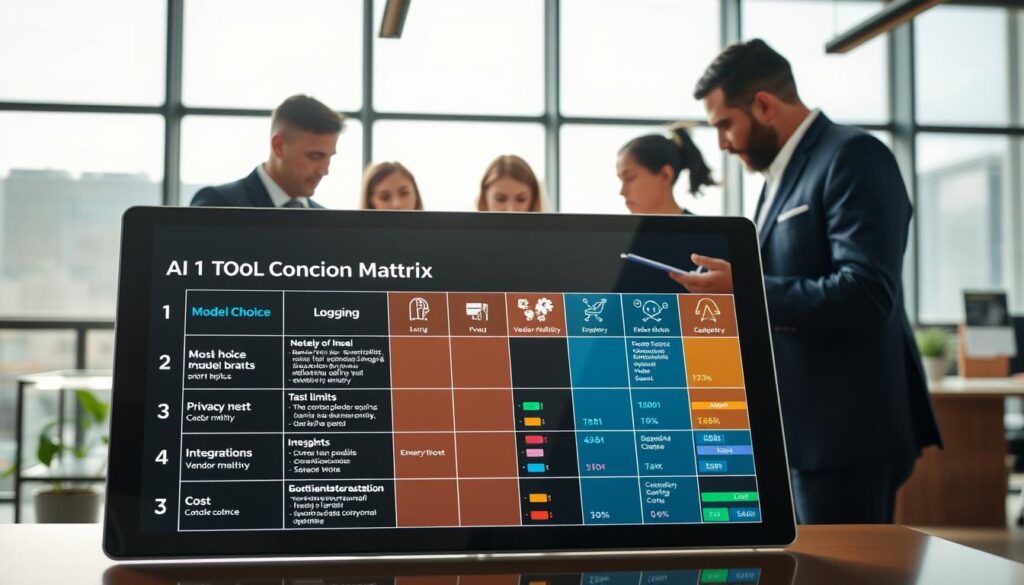
A unified scoring grid helps teams compare model energy use and task performance side by side.
The AI Energy Score project creates a standalone benchmark. It measures energy consumption across 10 common tasks and multiple modalities. Both open and proprietary models are included.
A public leaderboard tracks progress over time. Stakeholders can see relative ratings that turn raw power numbers into clear signals. This makes sustainability and performance easier to weigh.
| Task | Energy Use (J) | Relative Score | Latency (ms) |
|---|---|---|---|
| Text generation | 1,200 | 0.82 | 45 |
| Classification | 450 | 0.91 | 12 |
| Multimodal | 2,500 | 0.68 | 120 |
| Summarization | 800 | 0.88 | 30 |
- The framework normalizes hardware effects so comparisons stay fair.
- Relative scoring simplifies decisions about energy-efficient models and applications.
- Open leaderboard data encourages improvements in sustainability and performance.
Standardizing Energy Efficiency Ratings
Clear, consistent energy ratings make it possible to compare model footprints across vendors and hardware.
Standardized benchmarking ties software, hardware, and measurement practices to one set of metrics. Projects such as MLPerf evaluate performance across image and language workloads, while MLPerf Power Measurement lets teams report energy use during training and inference.
The Importance of Standardized Benchmarking
Open libraries like Zeus provide repeatable methods to log consumption and optimize deep learning runs. Ecologits adds carbon and resource estimates so users see more than watt-hours.
- The AI Energy Score builds on these efforts to produce unified ratings for both open and proprietary models.
- Consistent methodology ensures software and hardware configs are comparable, reducing unfair variability in reported footprints.
- Measured energy required per task helps organizations cut carbon emissions and manage data center demand.
Result: standardized energy ratings give buyers and operators clear signals about performance, cost, and environmental impact so sustainable choices become practical.
Evaluating Model Choice and Architecture
Model design strongly influences how much energy systems consume during inference and training. Small changes in architecture can cut processing needs without losing key capabilities.
Mixture of Experts Architectures
Mixture-of-Experts (MoE) routes inputs to specialized subnetworks. Google’s Gemini 2.5 Pro uses this approach to activate only needed experts per request.
This selective activation improves energy efficiency by lowering the active compute per query. It keeps latency and power use down while preserving performance on diverse tasks.
Compact Foundation Models
Compact models such as Gemma 3 270M pack a focused parameter set—170M embeddings and 100M transformer block parameters—so they run well on local hardware.
On-device processing cuts data transfer and central compute, making these efficient models attractive for privacy-sensitive applications and lower operational cost.
Knowledge Distillation
Knowledge distillation trains smaller student models to mimic larger teachers. Typical size reductions near 40% can translate into meaningful energy savings.
“One 2025 study applying distillation to ELECTRA reported a 23.934% reduction in energy use.”
Distillation plus careful architecture tuning yields efficient models that handle common text and moderation applications with less power.
- Use specialized architectures to match models to tasks and hardware.
- Favor compact models when on-device processing is required.
- Apply distillation to preserve performance while cutting energy and training cost.
Navigating Task Limits and Performance Metrics
Clear task caps and consistent metrics reveal how much energy a model will actually use in production.
The AI Energy Score benchmarks ten distinct tasks, from text generation to image classification. Each run uses a batch size of 1 to keep efficiency comparisons fair.
GPU energy consumption is the primary metric. Teams read results as watt‑hours per 1,000 queries. That makes energy consumption meaningful for budgeting and sustainability goals.
Energy use is summed across preprocess, prefill, and decode phases. Measuring each phase separately gives developers granular data to optimize latency and power.
- Standard batch size 1 ensures apples‑to‑apples comparison between models and hardware.
- Using the NVIDIA H100 80GB as the baseline keeps hardware variance low.
- Phase‑level metrics help teams tune throughput, reduce consumption, and meet application limits.
Armed with these metrics, users can balance performance and power. Effective task limits let organizations scale processing while keeping energy and cost within expectations.
The Role of Logging and Transparency in Sustainability
Detailed tracking of compute and memory use makes it possible to measure real model energy in production. Good logging turns vague estimates into clear metrics that teams can act on.
Tracking Energy Usage with CodeCarbon
CodeCarbon records energy use across CPU, GPU, and RAM during inference. It pulls precise GPU measures via the NVIDIA System Management Interface (nvidia-smi) so GPU consumption is not guessed.
Transparency is central to the AI Energy Score methodology. Submitters must disclose precision and quantization settings so reported model energy reflects how the system actually ran.
- Logging total energy consumption including CPU and RAM prevents hidden power costs.
- Public leaderboard entries encourage teams to improve energy efficiency and lower carbon emissions.
- Clear reports help users compare model energy and tune training or inference for better performance.
Result: consistent, auditable logs let organizations reduce environmental impact while keeping systems reliable and efficient.
Privacy Considerations for On-Device Processing
Local inference shifts work from large data centers to personal hardware, improving privacy and reducing energy consumption.
Data Security Benefits
Running models on-device keeps sensitive inputs on the user’s device. This removes the need to send private data to external servers.
For example, Gemma 3 270M can handle a 256,000-token vocabulary entirely on-device. That eliminates repeated trips to energy‑hungry data centers and boosts data protection.
Edge Computing Advantages
Processing locally lowers latency and improves performance for real‑time applications. It also cuts network usage and lowers overall power draw.
By reducing reliance on remote data centers, organizations gain system-level efficiency and can deploy energy-efficient models on phones and laptops.
| Deployment | Privacy | Energy Consumption |
|---|---|---|
| On-device | High — data stays local | Low — reduced data center use |
| Cloud | Medium — data transmitted off-device | Higher — depends on data center load |
| Hybrid | Variable — selective local processing | Moderate — balances local and remote usage |
Takeaway: Prioritize on-device processing when privacy and lower energy use matter. Edge deployments let teams deliver strong performance while reducing strain on data centers.
Assessing Vendor Maturity and Environmental Commitments
Evaluating a vendor means checking if they publish clear data on energy usage, emissions, and model performance. Look for detailed reports that break down training and inference energy by hardware and task.
Vendors that take part in standardized benchmarking show higher maturity. Participation signals a willingness to be measured against common ratings and lets enterprises compare systems on a level field.
Transparency matters. Mature providers release carbon and sustainability statements, hardware inventories, and reproducible logs. These documents help teams forecast operational impact and plan sustainable deployments.
- Demand standardized energy ratings and benchmark results.
- Require published energy and emissions reports tied to specific models and tasks.
- Prefer vendors that supply detailed performance and hardware data for audits.
Takeaway: Choosing mature vendors reduces procurement risk and supports long-term sustainability goals. The AI Energy Score offers a practical framework to evaluate commitments and find energy-efficient models that meet enterprise needs.
Integrating Energy-Efficient Tools into Enterprise Workflows
Choosing platforms that centralize efficient models helps teams scale with predictable power use.
Platforms like Magai bring energy-efficient models such as Google Gemini and Claude into one interface. This central view helps users pick the right model for a given task and reduce redundant compute.
Selecting a multi-model platform lowers operational expense and makes it easier to enforce sustainability practices. Teams can route light tasks to compact models and reserve larger models for high-value jobs.
Selecting Platforms for Scalable Efficiency
Match model size to task to avoid wasting cycles. These platforms also simplify logging and performance monitoring so teams can track usage and energy in production.
- Reduce demand: send routine tasks to smaller models to cut energy use and cost.
- Standardize deployment: use a platform that supports multiple models and reproducible metrics.
- Operationalize ratings: feed AI Energy Score outputs into procurement and runbook decisions.
Adopting these energy-efficient solutions streamlines workflows, preserves performance, and lowers the overall energy footprint of enterprise data processing.
Analyzing Cost Implications of Sustainable AI
A clear cost picture links joules per response to electricity bills, hardware needs, and carbon outcomes. Small models often deliver huge savings on both operational expense and environmental impact.
Consider concrete numbers: Llama 3.1 8B uses about 114 joules per response, while Llama 3.1 405B can consume 6,706 joules. That difference multiplies quickly at scale and raises energy required per query.
Smaller models run on everyday hardware. This can remove costly cloud instances and cut electricity and cooling bills tied to data centers. The lower energy consumption also reduces water demand and carbon emissions linked to power generation.
Practical steps: deploy specialized, energy-efficient models for routine tasks and reserve larger models only when needed. This approach trims waste while keeping performance where it matters.
- Smaller models mean lower energy use and smaller electricity bills.
- Reduced energy required lessens data center load and carbon emissions.
- Energy-efficient models offer a clear financial and sustainability incentive.
Hardware Optimization for Reduced Carbon Footprints
Optimizing hardware is one of the fastest ways to shrink an application’s carbon footprint without changing model logic. Choosing chips built for matrix math and matching software to silicon cuts energy use and improves performance.
Specialized Hardware Accelerators
TPUs, NPUs, and modern GPUs handle matrix multiplications far more efficiently than general CPUs. Using these accelerators lowers power draw per inference and speeds up common tasks.
The NVIDIA H100 80GB remains a standard benchmark across experiments, keeping energy consumption numbers comparable.
Quantization and Precision Settings
Lowering numeric precision—moving from FP32 to INT8 or INT4—can cut energy use by up to ~45% in inference. Quantization reduces memory bandwidth and compute, trimming the footprint of training and serving.
Hardware-software co-optimization matters. Tailoring a model’s kernels and compilation settings to an SoC or accelerator preserves accuracy while minimizing energy usage.
- Practical tip: combine specialized chips with quantized models to reduce carbon impact without sacrificing user-facing quality.
Future Trends in Sustainable AI Development
The next wave of compute favors neuromorphic and optical processors that can cut energy use by shifting how circuits operate. These technologies use spikes or light to move information, which reduces power per operation and improves sustained performance on common tasks.
Software advances will match hardware gains. Better compression, sparse attention, and new architectures let models keep accuracy while needing less compute. That lowers energy during both training and inference.
Industry-wide standards will matter. Standardized energy ratings create clear signals that guide procurement and design. When ratings are common, vendors and developers optimize toward real-world sustainability goals instead of proprietary claims.
Broad adoption depends on collaboration. Researchers, policymakers, and enterprise teams must share results, fund hardware research, and update regulation. That collective effort will reduce carbon impact and help data-driven services scale responsibly.
- Specialized hardware and compression will drive future gains.
- Standard ratings will reward energy-efficient models and honest reporting.
- Coordination across the ecosystem is essential to meet climate targets.
Conclusion
Certain benchmarks turn vague claims into concrete signals about model energy and task suitability. Measured metrics make it easier to weigh energy consumption against performance and cost.
Prioritize energy efficiency and optimized hardware to lower carbon and electricity impacts in production. Use standardized energy ratings and clear logging to compare model energy and footprint across deployments.
Adopt energy-efficient models for routine tasks and reserve larger models for high-value work. This approach reduces operational cost, data center strain, and greenhouse gas emissions while keeping user-facing performance strong.
Final thought: sustained progress depends on shared metrics, transparent ratings, and collective action to improve efficiency across systems and hardware.