Energy-Aware workflows are now a practical part of modern systems design. Teams in the United States can cut processing time and energy consumption by reusing briefs and batching research.
Bernard McShea, founding program manager for ML2P, stresses that mapping model performance to electricity and hardware power is essential to raise accuracy. This approach ties software and training to real-world energy usage.
Developers should limit endless regeneration cycles and set a standardized part of the process to check facts once. That simple change reduces redundant data processing and preserves resources.
With the right tools and a clear process, teams can balance intelligence, performance, and sustainability. Small design and analysis choices today lead to big reductions in energy consumption and improve long-term system efficiency.
The Growing Necessity of Energy-Aware Tips for AI Content Planning
Forecasts that data centers could consume 21 percent of global electricity by 2030 make system-level energy choices urgent. The environmental impact of large-scale artificial intelligence now shapes how teams design models and manage data.
Scientists at the MIT Lincoln Laboratory Supercomputing Center lead research that aims to cut energy use without harming model performance. Their work shows that smarter scheduling, transparent reporting, and hardware tweaks can lower overall consumption.

For example, the massive energy usage tied to training a single large model highlights why clear information about carbon footprints matters today. Developers and users need access to that data to make better decisions about power and infrastructure.
“Providing clear information about the carbon footprint of AI models is a necessary step to help users and developers make better decisions today.”
As data centers grow, teams must prioritize software and hardware optimizations. Understanding energy usage and power demands will help keep research sustainable while preserving performance and useful information.
Streamlining Content Workflows to Reduce Computational Waste
A tighter workflow that reuses assets and batches tasks cuts redundant processing across training and inference. That approach saves time and lowers energy use while keeping model performance strong.
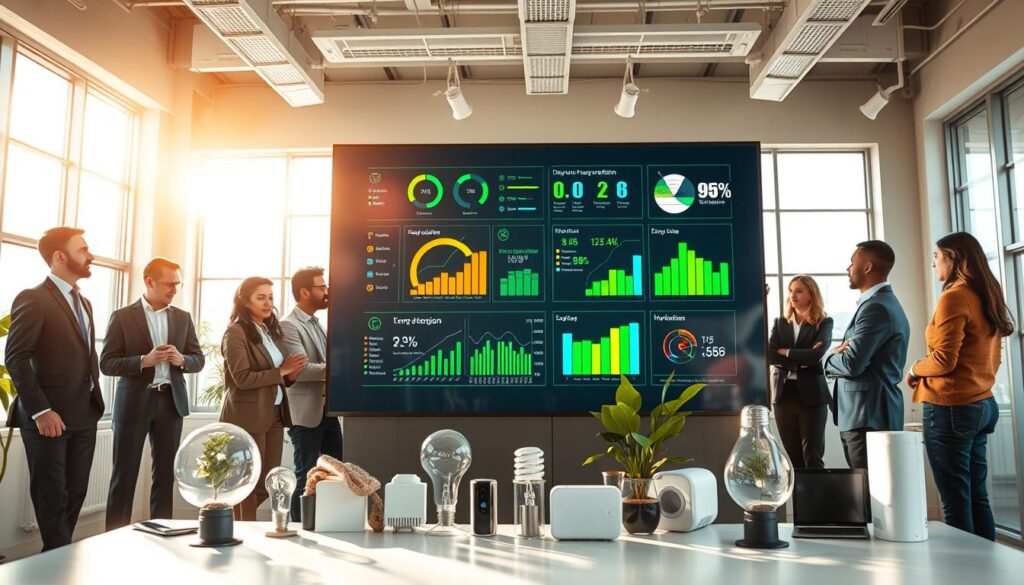
Reusing Briefs and Assets
Keep a library of reusable briefs, prompts, and reference assets. Reuse reduces duplicated work and trims processing when teams run models.
Developers and scientists can share standardized templates to speed work and limit needless variations.
Batching Research Tasks
Group related research into single runs. Batching cuts repeated data loads and gives hardware longer, efficient runs.
In one practical example, Business Energy UK notes ChatGPT can use 40 MWh per day — a reminder that batching saves real power.
Limiting Iterative Variations
Set a cap on regeneration cycles and define clear review points. Fewer iterations mean less processing and lower energy consumption.
Use lightweight tools to monitor usage, and match model choices to the task to reduce energy and resource waste.
Implementing Hardware and Infrastructure Power Management
Simple limits on GPU wattage can deliver measurable drops in system energy use without harming model accuracy. Researchers at the LLSC found that capping GPU power reduced energy consumption by 12 to 15 percent across several models.
Power-Capping and Thermal Management
Limiting GPU power to defined wattages — for example, 150 W during BERT training — saved the equivalent of a U.S. household’s week of electricity. That practical example shows how hardware controls cut consumption and reduce cooling load.
Software hooks in the Slurm scheduler let operators set power limits on a job-by-job basis. This process helps keep temperatures steady, lowers stress on cooling systems, and improves hardware reliability.
| Technique | Effect on Energy | Impact on Performance |
|---|---|---|
| GPU power-capping | 12–15% reduction | Minor, task-dependent |
| Job-level power limits (Slurm) | Optimized usage per task | Consistent across runs |
| Thermal management | Lower cooling electricity | Improved hardware lifespan |
Performing a detailed analysis of energy usage lets teams match models and tasks to the right hardware. That process reduces energy waste and keeps training time and accuracy within expected ranges.
- Apply power budgets per job.
- Monitor temperature and adjust limits.
- Use scheduler software to enforce policies.
Advanced Techniques for Efficient Model Training and Inference
Smart stopping rules and right-sized hardware make modern model work both faster and greener. These methods cut wasted processing and let teams meet quality targets while lowering energy and power use.
Early Stopping for Hyperparameter Optimization
Early stopping halts trials that show poor promise. Vijay Gadepally of the LLSC notes this can reduce energy used in training by up to 80 percent.
Stop unpromising runs early, focus compute on the best candidates, and log results to guide later experiments. This process saves time, energy, and researcher effort.
Matching Models to Efficient Hardware
Use a hardware-selection tool to map models and tasks to the right devices. Matching heavy models to high-power GPUs and lighter tasks to CPUs can cut energy consumption by 10–20 percent.
Developers should test performance and energy usage on representative data. That way, teams keep accuracy while reducing overall processing and resource waste.
- Example: apply early stopping during hyperparameter sweeps to trim long runs.
- Use a scheduler or tool that routes tasks to appropriate hardware based on model size and latency needs.
- Track energy consumption alongside accuracy to balance cost, time, and performance.
Adopting a Full-Stack Approach to AI System Design
When developers pair model architecture with hardware constraints, they unlock major energy and performance gains.
A full-stack approach treats software and hardware as a single design problem. This method helps teams tune systems to meet latency, safety, and power goals.
Rajendra Bishnoi and colleagues at TU Delft show that neither chips nor algorithms alone deliver optimal results. Developers must use deep knowledge of both domains to find bottlenecks and trade-offs.
Balancing intelligence, model size, and training schedules reduces wasted cycles. Teams can make models smaller, smarter, and faster while keeping real-world reliability.
| Layer | Focus | Benefit |
|---|---|---|
| Hardware | Power caps, thermal control | Lower energy draw, stable performance |
| Software | Efficient code and schedulers | Fewer cycles, faster training |
| Model | Right-sized architectures | Better accuracy per watt |
Building a Culture of Transparency and Accountability
Clear, consistent reporting turns energy use from an afterthought into actionable information. Organizations should adopt common metrics so teams can compare systems, measure impact, and set goals.
Standardizing Energy Reporting Metrics
Start with simple, job-level measures: watts per hour, carbon equivalent, and percent utilization during training. These values make energy consumption visible to every user.
The LLSC and other labs are building tools that show each job’s energy usage, similar to a home energy report. That visibility helps developers choose efficient models and hardware.
Researchers work with vendors like Intel to ensure hardware can report accurate energy and power data across platforms. Standard metrics let data leaders aggregate results and perform meaningful analysis.
“Providing clear information and standardized metrics empowers teams to reduce consumption and make accountable choices.”
Transparency drives accountability. When energy is treated as a measurable resource, teams can track progress and align model development with broader sustainability goals today.
Conclusion
Practical steps across the stack can cut energy use while keeping models accurate and reliable.
Achieving efficiency means pairing hardware management with smarter software and clear team practices. Use power-capping and early stopping to shrink the energy footprint of training and inference.
Standardize data reporting and share results so teams compare runs and pick the best setups. That transparency makes it easier to match a model to the right device and workload.
When groups track energy, tune hardware, and adopt simple rules, performance and conservation improve together. These choices help the United States tech landscape scale sustainably and responsibly.